
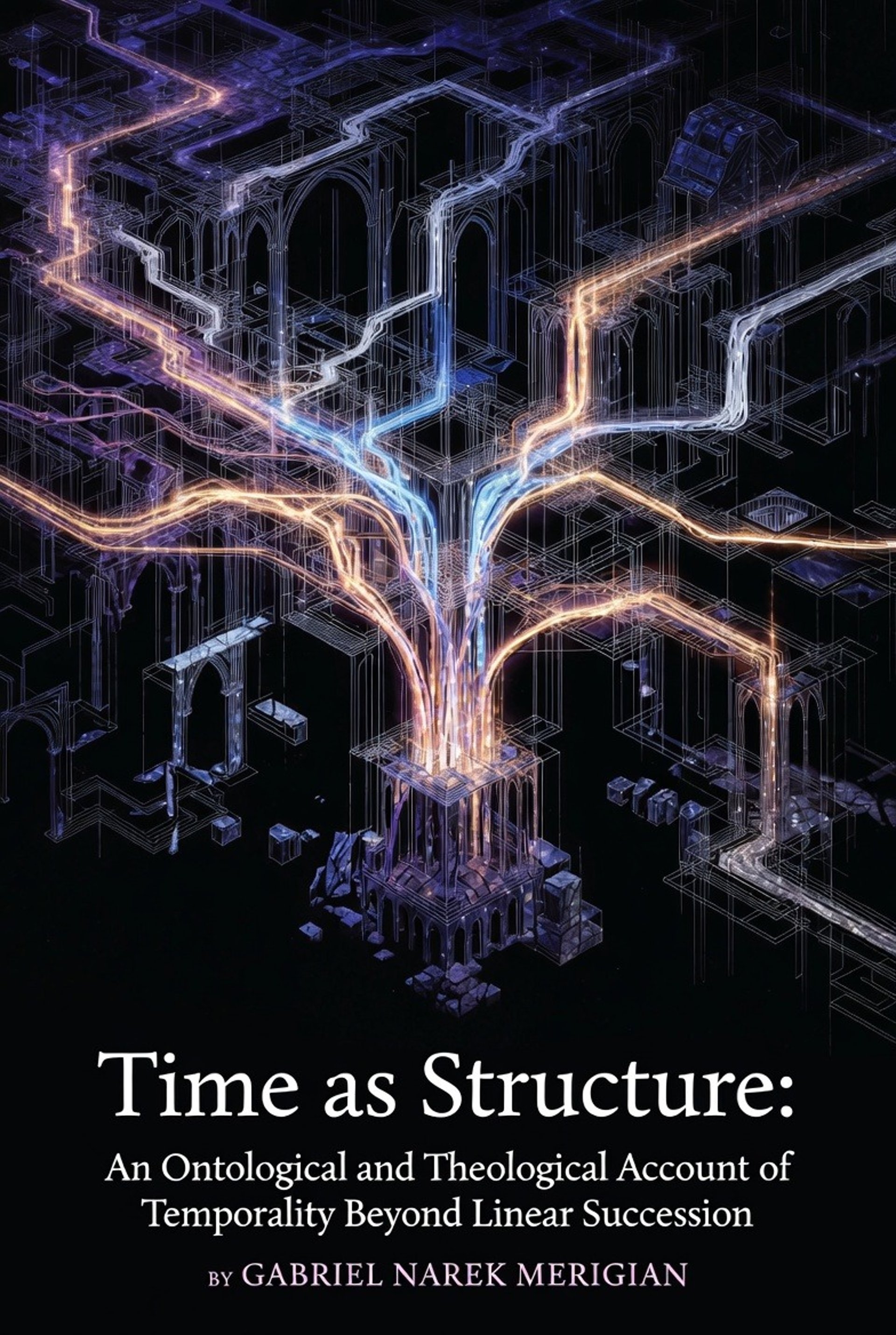
Time as Structure: An Ontological and Theological Account of Temporality Beyond Linear Succession
A Note from the Author, Gabriel N. Merigian
“I founded Avedis Daily News to be a beacon of truth and integrate the teachings of the most truthful and joyful news of the Gospel of our Lord Jesus Christ. While working on separate endeavors in the pursuit of Proclaiming Jesus as the Son of the One and True God, I also ended up authoring a rather unique dissertation, which utilizes several building blocks of Classical, Modern, and Christian Philosophical proofs to create a terminally logical proof for the necessity of the divine. Further works will include applications and proofs on the Christian God being the only God who fits this logic. However, for now, we wanted to publish this to disseminate the work as quickly as dissenters will likely spring up to shout it down with logical fallacies they are betting on you not comprehending. Therefore, I thought it most fitting to begin the exclamation of the Truth where God had already provided me with the pre-cognitional understanding of the necessity to prepare, here on Avedis Daily.”
From Temporal Flow to Temporal Structure
Modern thought has inherited a narrow picture of time. Whether treated as a uniform container in classical mechanics, a coordinate within spacetime geometry, or a subjective stream of consciousness, time is typically understood as a one-dimensional order in which events are arranged. Time as Structure argues that this assumption is inadequate to account for the features of temporal reality we encounter in lived experience, moral agency, and rational inquiry.
Merigian proposes that temporality must be understood as an ontological structure, a real system of constraints and relations that makes coherent persistence, responsible agency, and intelligible history possible. The work forms the third installment of a philosophical trilogy examining cognition, reality, and intelligibility. Building on the Multiversal Cognition Argument (MCA), which establishes that coherent cognition requires an extratemporal unifying principle identified with the Logos, the dissertation applies this constraint to the metaphysics of time itself. If cognition presupposes such unity, then the temporal order within which cognition operates cannot be metaphysically neutral or self-grounding.
Why Linear Models Fail
The dissertation begins from a simple observation: ordering events as "earlier" and "later" does not explain why a life can remain coherent across decades, why decisions bind future possibilities, or why personal identity persists through radical change. Linear models describe succession, but they cannot account for integration.
Three pressures expose this limitation. First, reality involves genuine alternatives. Whether described through modal logic, counterfactual dependence, or multiverse formalisms, the space of what could occur is not exhausted by what does occur. A purely linear timeline has no resources for representing how unrealized possibilities shape present meaning and constrain future options.
Second, cognition exhibits unity across time. Human agents do not experience disconnected moments; they recognize themselves as the same subject who promised, regretted, anticipated, and chose. That continuity requires more than temporal adjacency, it demands a principle of integration that succession alone cannot provide.
Third, choices have enduring structural effects not captured by causal succession. Commitments, betrayals, education, and moral formation alter what can stably follow. Some trajectories become feasible; others grow fragile or collapse into incoherence. These are structural differences, not chronological ones.
From these considerations, Merigian concludes that time must be capable of bearing "load", it must support, constrain, and integrate trajectories rather than merely host them in neutral succession.
A Formal Account of Structural Time
The dissertation treats this proposal with formalism. It constructs a modal–temporal framework augmented with structural predicates: coherence, stability, support, constraint, and collapse.
Within this system, histories are not simply sequences but paths through a structured field. Some paths remain coherent under accumulated constraints; others cannot be extended without contradiction or fragmentation. "Collapse" here denotes not physical catastrophe but a failure of intelligibility, a trajectory that can no longer sustain agency, identity, and rational continuity.
From these formal definitions, the work derives a result: if coherent histories exist, there must be a unifying integrator capable of relating branching paths within a single intelligible order. Under the assumptions of the MCA and standard S5 modal logic, the possible existence of such an integrator entails its necessity. The role required, extratemporal, cognitive, unifying, corresponds to what the earlier argument designates as the Logos. This identification emerges not as a theological stipulation but as a formal consequence of the conditions under which temporal coherence is possible.
What "Three-Dimensional" Temporality Means
The claim that time is "three-dimensional" requires qualification. This is not a proposal to add new spatial axes to physics or a speculative cosmology. Rather, it identifies three irreducible structural degrees of freedom for any adequate model of temporality:
Continuation – successor relations that permit ordered progression through time.
Integration – relations that bind alternative branches into a unified domain of meaning and possibility.
Load-bearing stability – relations that register accumulated constraint and determine whether trajectories can persist coherently or must collapse.
These are not geometrical dimensions but architectonic ones, independent parameters without which persistence, agency, and intelligibility cannot be modeled without loss.
Link to Download the full Thesis Publication


Written By: AD NEWS
AD News Editorial Team collaborates on stories in-house and with external reporters to bring you exclusive pieces, like this one.
Phenomenology, Physics, and Moral Weight
Merigian complements the formal framework with phenomenological analysis. Memory, anticipation, responsibility, and narrative identity all reveal that the past remains operative and the future exerts real constraint. The present is not a dimensionless point but a site of active synthesis. These features are treated not as subjective illusions but as evidence that temporality itself possesses internal organization.
The dissertation engages contemporary physics. Spacetime geometry is acknowledged as indispensable for describing measurement and causal regularities, yet insufficient for explaining why histories differ in stability or why agency carries enduring significance. Drawing a limited analogy to general relativity, where mass-energy conditions physical curvature, the work proposes that noetic acts (decisions, valuations, moral recognitions) condition the integrity of temporal trajectories, not physically but metaphysically.
Time, on this view, is neither reducible to physical law nor detached from it. It functions as a constraint-bearing condition within which physical and rational order jointly unfold.
Theological Integration
The theological implications follow from the same intelligibility constraint that motivates the metaphysics. If temporal coherence is real and not a brute fact, it requires a ground that is not itself another temporal fact. The Logos fulfills this role as the rational unity capable of integrating multiplicity without dissolving distinctions or collapsing alternatives.
Moral action acquires structural significance. Actions are not only evaluated externally; they reshape the agent's embedding within temporality, reinforcing or destabilizing coherence. Freedom is preserved not as an arbitrary choice but as the capacity to participate intelligently in an ordered field of genuine possibilities. Providence is reinterpreted not as micromanagement of a fixed timeline but as rational governance of the structural conditions under which coherent histories can unfold.
Significance
Time as Structure offers neither a popular manifesto nor a speculative cosmology. It attempts to resolve persistent problems at the intersection of metaphysics, logic, phenomenology, philosophy of physics, and theology. Its central claim is straightforward yet demanding: if time were merely a linear succession, much of what we take to be meaningful about agency, responsibility, and history would be unintelligible. If time were a mere illusion, coherence itself would become inexplicable. Treating time as structure provides a third alternative, one that preserves empirical science, respects lived experience, and supplies the formal conditions necessary for intelligibility.
The consequences extend beyond philosophy of time, reshaping how cognition, moral agency, and even physical law are understood to depend on temporality, and why temporality itself cannot be metaphysically self-sufficient. The dissertation is best understood not as revising a single theory but as re-specifying the conditions under which any theory of reality, agency, or meaning can remain coherent.
Avedis Daily LLC © 2026
This material may not be published, broadcast, rewritten, or redistributed. ©2026 Avedis Daily, LLC. All rights reserved. Quotes displayed in real-time or delayed by at least 15 minutes.