
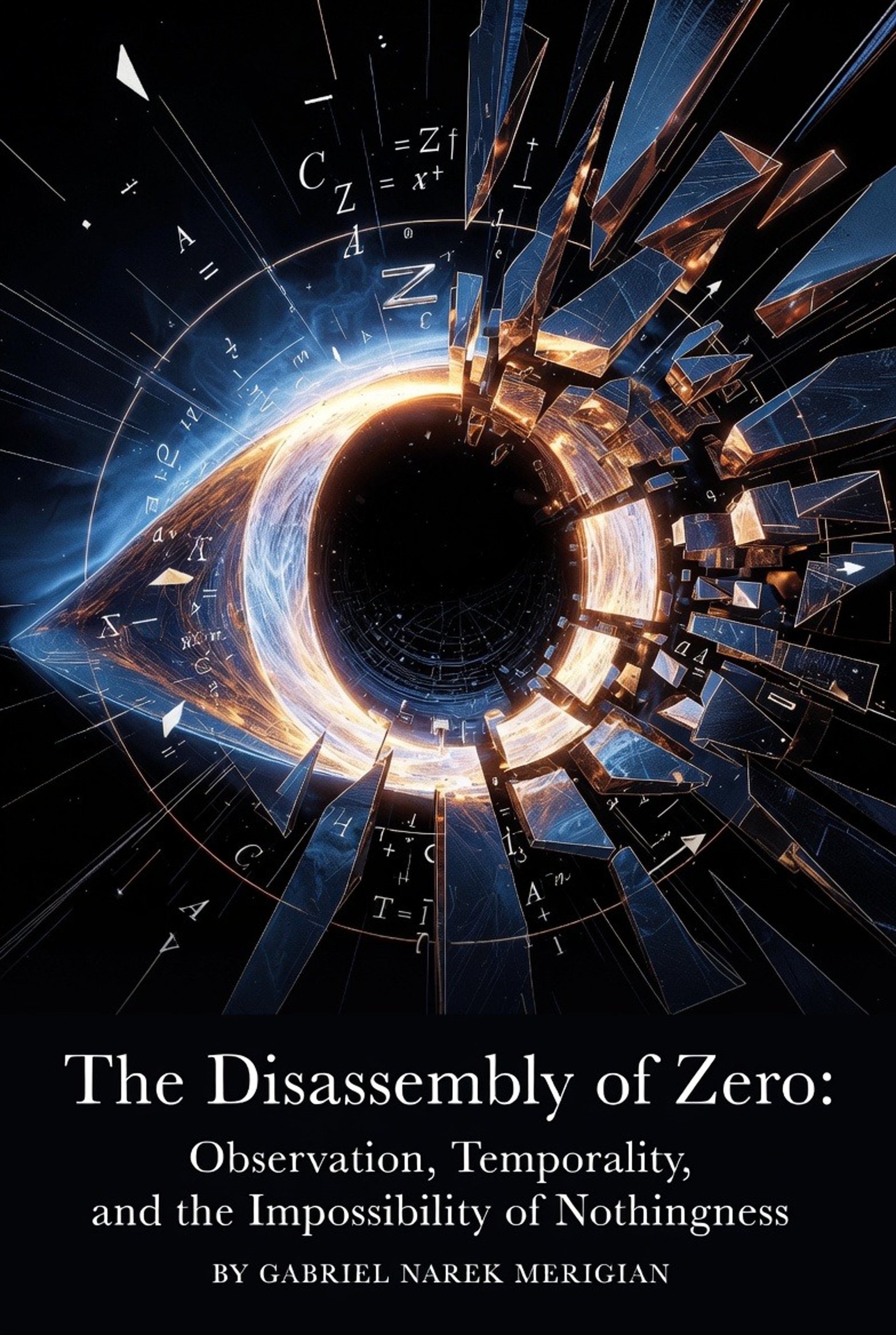
The Disassembly of Zero: Observation, Temporality, and the Impossibility of Nothingness
A Note from the Author, Gabriel N. Merigian
“I founded Avedis Daily News to be a beacon of truth and integrate the teachings of the most truthful and joyful news of the Gospel of our Lord Jesus Christ. While working on separate endeavors in the pursuit of Proclaiming Jesus as the Son of the One and True God, I also ended up authoring a rather unique dissertation, which utilizes several building blocks of Classical, Modern, and Christian Philosophical proofs to create a terminally logical proof for the necessity of the divine. Further works will include applications and proofs on the Christian God being the only God who fits this logic. However, for now, we wanted to publish this to disseminate the work as quickly as dissenters will likely spring up to shout it down with logical fallacies they are betting on you not comprehending. Therefore, I thought it most fitting to begin the exclamation of the Truth where God had already provided me with the pre-cognitional understanding of the necessity to prepare, here on Avedis Daily.”


Challenging the Hidden Axiom of Modern Cosmology
In contemporary scientific discourse, the concept of "nothing" has achieved remarkable explanatory power. From quantum vacuum fluctuations to "something from nothing" cosmologies, the notion that reality can emerge from absolute nothingness has become a cornerstone of popular scientific understanding. Yet this influential dissertation argues that this widespread acceptance rests on a fundamental philosophical error: the illegitimate promotion of "zero" from a useful mathematical symbol to an ontological ground of reality itself.
The Disassembly of Zero forms the crucial second installment of a philosophical trilogy examining the foundations of cognition, time, and being. While the first dissertation established that human cognition requires an extratemporal grounding principle (the Logos), and the third explores time's structural coherence, this work performs the essential negative task of eliminating a false alternative that has dominated modern explanatory frameworks.
The Core Argument: From Mathematical Tool to Metaphysical Mistake
The dissertation's central insight is deceptively simple yet profound: there exists a critical difference between "operational zero", a legitimate mathematical limit or placeholder, and "ontological zero", a purported state of absolute nothingness. Modern cosmology and physics frequently commit what the author identifies as "metaphysical inflation," treating mathematical conveniences as descriptions of reality itself.
This category error manifests across multiple domains. Quantum field theory's vacuum state, far from being "nothing," presupposes fields, spacetime structure, governing equations, and permissible excitations. Cosmological singularities mark the breakdown of mathematical models, not actual physical states. Zero-energy universe arguments confuse accounting results (where positive and negative terms cancel) with the grounds of existence. In each case, the absence of classical particles or net values is rhetorically collapsed into absolute ontological absence.
The Observational Constraint: Why We Cannot See Backward to Nothing
A particularly powerful dimension of the argument concerns observation and temporality. The dissertation establishes that all observation occurs within irreversible time, no observer has ever accessed alternate unrealized outcomes or reversed temporal flow. Yet explanations invoking ontological zero typically depend on "retrodiction," mathematically modeling backward to supposed origins.
This creates an insurmountable problem: retrodictive models reaching boundaries where equations break down cannot legitimately claim that "nothingness" exists at those boundaries. Such claims commit what the dissertation terms the "Non-Witness Problem", treating absence of observation as evidence of ontological absence. Light has never been observed to reverse; time has never been experienced as reversible. Claims that reality collapses into zero-states at extreme boundaries are inferential projections, not observations, and thus fail by the very empiricist standards often invoked to support them.
Link to Download the full Thesis Publication


Written By: AD NEWS
AD News Editorial Team collaborates on stories in-house and with external reporters to bring you exclusive pieces, like this one.
The Cognitive Surplus and the Necessity of Grounding
Beyond epistemology and physics, the dissertation connects the rejection of ontological zero to fundamental features of human cognition. Humans possess awareness of unrealized possibilities and counterfactual scenarios that cannot be derived from observing a single realized history. This "cognitive surplus" requires explanation.
If reality ultimately rests on "nothing," this surplus becomes inexplicable, ontological zero, lacking all structure and relations, cannot ground the awareness of alternatives. Only a unifying extratemporal principle can account for cognition's capacity to apprehend both actualities and possibilities. Thus, eliminating zero as a false ground reveals the necessity of what the trilogy identifies as the Logos.
Cultural and Civilizational Stakes
The work extends beyond technical philosophy to examine why "nothingness" rhetoric exerts such cultural force. By appearing to settle ultimate questions while avoiding metaphysical commitments, ontological zero provides what the dissertation calls "closure without obligation." If everything arises from nothing, existence requires no explanation, carries no inherent meaning, and implies no purpose beyond itself.
This seemingly neutral position has profound consequences. It undermines agency by treating alternatives as illusions, erodes moral accountability by denying robust grounding for responsibility, and forecloses genuine inquiry by mistaking explanatory limits for final answers. The dissertation argues that this represents not scientific humility but premature philosophical closure masquerading as empirical restraint.
Methodology and Contribution
Rigorously structured with formal definitions, axioms, and theorems, the work engages technical physics, contemporary cosmology (including post-JWST observations), philosophy of time, and metaphysical grounding theory. It addresses objections ranging from mathematical realism to physicalism, demonstrating that its core claims survive scrutiny from multiple disciplinary perspectives.
The dissertation's ultimate contribution is clarificatory rather than speculative: by demonstrating that "nothingness" cannot coherently function as ontological ground, it removes a false alternative and restores the conditions under which questions about reality's ultimate grounding remain meaningful. In doing so, it completes a comprehensive argument that cognition, temporality, and intelligibility require grounding in Logos rather than absence, preserving rather than eliminating the mystery of existence while insisting that mystery remains comprehensible only if genuinely grounded.
Link to Download the full Thesis Publication
Avedis Daily LLC © 2026
This material may not be published, broadcast, rewritten, or redistributed. ©2026 Avedis Daily, LLC. All rights reserved. Quotes displayed in real-time or delayed by at least 15 minutes.